

1
IntakeQuestion 1 of 6
2
Pilot MatchLocked until intake
3
Review PacketReady after match
4
Safety ProofSupporting evidence

Find the safest first AI pilot.

Accounting firm leaders reviewing workflow notes and a LedgerPilot AI discovery dashboard.
Guidance around the workflow, with the firm keeping the decision.

Talk to the discovery agent. It finds the accounting workflow pressure, writes the sidecar notes, and prepares a partner packet without client files.

Discovery agent Question 1 of 6 · workflow notes only
Draft in progress
LedgerPilot discovery agent

Answer in plain English. I’ll ask about tax, bookkeeping, billing, notices, front desk, payroll, CAS, and audit support so the firm can decide where AI may help. Workflow notes only.

Tax Bookkeeping CAS Billing Audit support Front desk Notices Payroll workflow

The safest AI-use recommendation starts with the pressure point.

Complete the intake to see where AI could support the workflow, why that path fits, and what remains under firm control.

AI-use recommendation

Complete the intake to choose the safest first AI-use path.

LedgerPilot uses the pressure point, starting trigger, systems, approver, and 30-day outcome to recommend where AI could support the team without taking over the work.

Why this use case

  • High partner visibility and clear business value
  • Repeatable workflow with measurable leakage
  • Low tax judgment risk when drafts stay reviewed

Risk and security boundary

  • No client files used during discovery
  • Approved systems before implementation
  • Human approval before client-facing action

First-week planning step

  • Review 10 recent completed jobs
  • Confirm source notes, approval owner, and billing language pattern.

Proof metric

8-14/wk Invoices ready for manager review within 24 hours
Workflow notes, approval steps, and a LedgerPilot AI sidecar summary during an accounting discovery session.
The first useful answer usually comes from watching where the work slows down.

Start with the handoff, not the software pitch.

LedgerPilot keeps the conversation close to the way accounting firms actually work: documents arrive, staff chase context, managers review exceptions, and partners need a clear recommendation before any build begins.

  • Find the workflow trigger and the owner.
  • Name the approved systems before implementation.
  • Keep professional judgment with the firm.

The partner-ready review packet comes next.

The packet is the takeaway: pressure point, AI-use lane, support output, first-week action, proof metric, and approval point.

Partner review packet

Complete the intake to prepare the review packet.

The packet will explain why this AI-use path is safe, what it may help staff prepare, who approves it, and how the firm can prove value in 30 days.

Problem found Completed work is hard to bill cleanly

Revenue can be delayed when managers reconstruct billing details after the work is already done.

AI-use lane Billing review packet

Uses approved workflow notes to help prepare invoice language and exception flags.

Support output Manager-ready billing packet

Review-ready descriptions, unbilled work list, and follow-up queue.

Proof of completion Track time from work completion to manager billing review.

Manager or partner signs off before anything leaves the firm.
Second-pass scoping

Use free text when the workflow needs a closer look.

LedgerPilot can re-read a workflow description and suggest a safer AI-use lane. If the match changes, the packet returns to draft.

What part of the firm feels most repetitive, stressful, or harder than it should be?

Billing remains the recommended first AI-use path until a higher-fit workflow is selected.

Safety proof keeps people in control.

Reports, review history, and audit trail matter after the firm understands the recommended AI-use path.

Opportunity ranking

AI-use options stay comparable.

Workflow Impact Effort Risk
Billing Review SupportBest first use caseHighLowLow
Document Intake PlanningSecond use caseHighMediumMedium
Tax Notice RoutingReview controlsMediumLowMedium
Protected review area

Saved review trail is available when needed.

Saved intakes, outcome packets, report bundles, and audit events live behind access-code login.

IntakesSaved firm reviews
PacketsProduced outcomes
ReportsPrintable bundles
AuditActivity trail
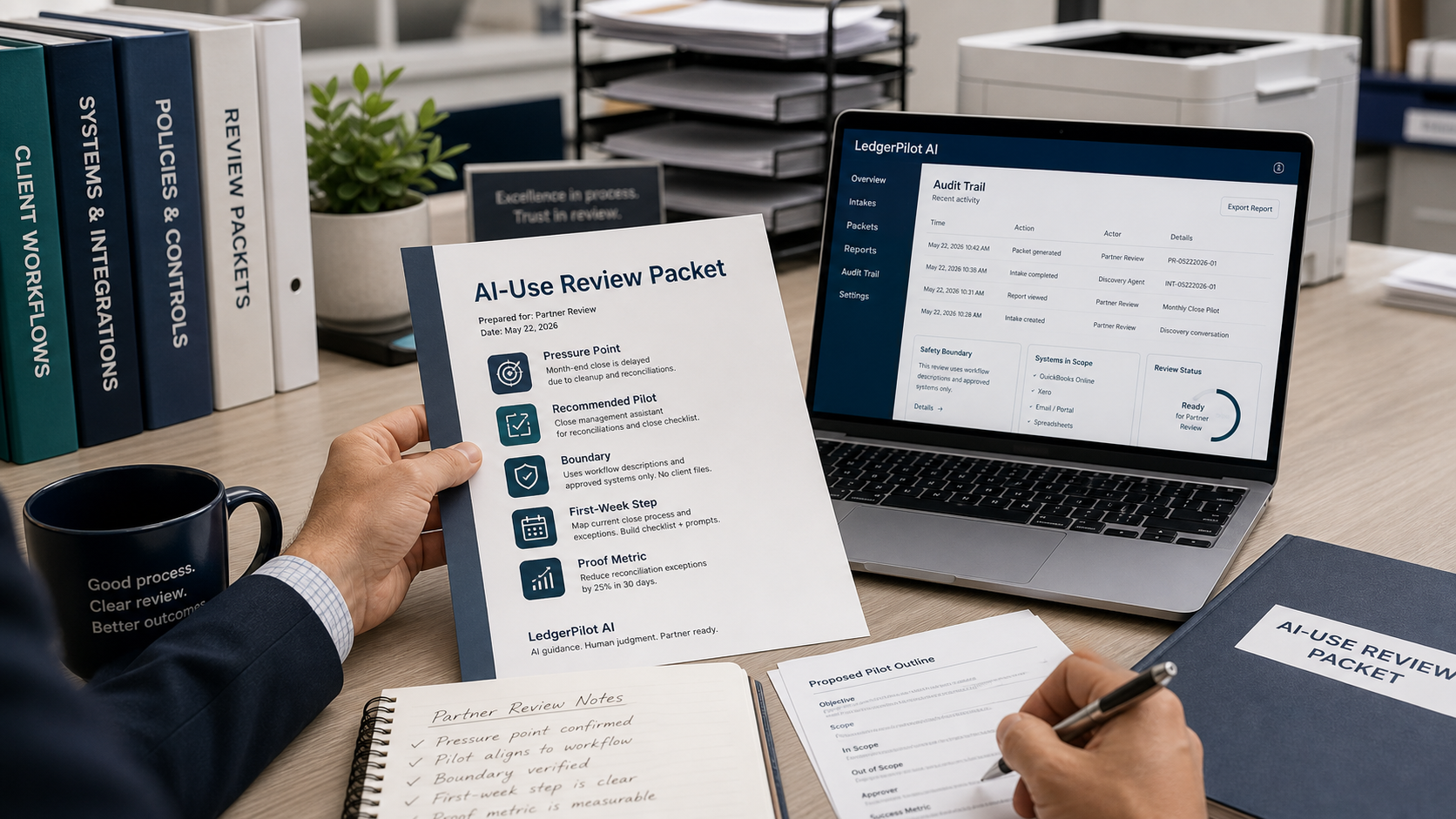
A LedgerPilot AI-use review packet beside an audit trail dashboard.
Security boundary

Discovery stays out of client data.

This public page asks for workflow descriptions, systems, approval owners, and target outcomes only.

No filesNo uploads in discovery
No adviceNo tax or payroll judgment
ReviewHuman approval required
ControlsVendor review before implementation

FAQ for partners and firm leaders.

What LedgerPilot does, where the research context comes from, and what remains human-owned.

What does LedgerPilot AI actually do?

LedgerPilot AI runs a short discovery conversation with an accounting firm, listens for workflow pressure, and recommends where AI could safely support the team. It does not do the accounting work. The output is a partner-ready packet with the pressure point, AI-use lane, first-week planning step, approval point, control boundary, and proof metric.

What kinds of workflows can it help scope?

It is designed to help firms evaluate AI support around accounting-firm operations, including tax workflow, bookkeeping, CAS, billing and WIP, audit support, front desk intake, payroll workflow, document routing, tax notice routing, partner visibility, and staff follow-up queues.

Where does the tax research information come from?

The current tax research layer uses a curated official-source registry. Today, that registry starts with IRS pages related to the One, Big, Beautiful Bill, including:

LedgerPilot uses those sources to shape workflow questions and cite source context. It does not turn those sources into final tax advice or client-specific recommendations.

See the full source and boundary page.

Which official IRS and DOL sources support payroll workflow scoping?

For payroll workflow and recordkeeping discovery, LedgerPilot links back to official government sources so firms can see the source context behind the questions:

Those links are used for workflow context only. LedgerPilot does not make payroll tax conclusions, wage-law conclusions, employee-specific recommendations, or filing decisions.

Is this giving tax or legal advice?

No. LedgerPilot can identify that a tax update may create a workflow need, such as staff training, organizer updates, notice routing, withholding questions, client communication review, or partner sign-off. A qualified professional still makes the tax, legal, audit, payroll, or accounting conclusion before anything client-facing is used.

Does LedgerPilot need client files?

No. Discovery should use workflow descriptions only. Do not enter client names, SSNs, EINs, tax IDs, bank data, payroll registers, W-2s, 1099s, client financial statements, or private financial documents.

What does the sidecar summary do?

As the conversation progresses, the sidecar captures the pressure point, firm context, workflow trigger, systems involved, approver, and desired 30-day outcome. Those notes become the working draft of the partner review packet.

How does LedgerPilot decide the recommended AI-use path?

It compares the conversation against controlled AI-use lanes such as billing review support, secure document intake planning, tax notice routing, partner visibility, and custom workflow discovery. The safest first use case is the one with a clear trigger, known source systems, human approval, measurable proof, and low client-data exposure during discovery.

What is live right now?

The public discovery guide, assistant message contract, tax research source registry, protected admin review area, printable report flow, VPS service, Cloudflare edge route, and NAS backup path are in place. The next production step is a reviewed retrieval store and LLM adapter with the same professional-review boundary.

What should a firm expect after the first conversation?

A clear recommendation for one controlled AI-use path, why it was selected, what should stay out of scope, who must approve the output, what to plan first, and how the firm can measure value within 30 days.

Start with one safe way to use AI, not a generic AI roadmap.

Use the intake to find the pressure point, name what stays human-owned, and leave with a packet a partner can actually review.